Water, Predatory Mites, and Miticides Are Useful Tools for Mitigation
Mites can be a significant pest on southern highbush blueberries (SHB) in Florida, especially during the warm and dry months of fall. To date, the southern red mite (Oligonychus ilicis) is the primary mite pest attacking SHB plants in Florida, causing damage including the bronzing of leaves and lower photosynthesis to support the plants’ growth and fruit development. Recently, another mite, Eotetranychus carpini (Oudemans) (Acari: Tetranychidae)has been recorded feedingon SHB in Florida and causing economic damage.
Description and Life Cycle of the Southern Red Mite
Populations increase under favorable weather conditions, with temperatures between 60 – 86°F and less frequent rainfall, typically during the fall to winter seasons in Florida. The red mite’s life cycle can be completed within two weeks under these conditions and overlapping generations can occur, doubling populations within five days and increasing their potential for substantial yield impact. Adults are similar in appearance to the red form of twospotted spider mites. Eggs are red to brown and hatch into pale six-legged larvae, with the nymphal stages having eight legs and becoming progressively darker and larger as the mite progresses through its development. Adults are about 0.016 inches (0.4 mm) long and red or brown to deep purple in color, with lighter colored legs. Females are slightly larger than males and have a more rounded body shape (Fig. 1).
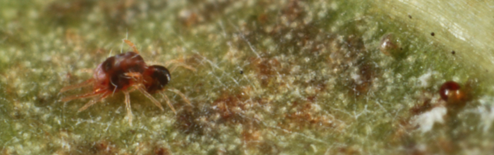
Figure 1. Southern red mite adult female and male mating, and one egg (right).
Credits: L. Buss
Damage
The main symptom associated with southern red mite injury is the bronzing of leaves, with the intensity of bronzing proportional to the level of infestation (Fig. 2). The southern red mite feeds on plant tissues by inserting their piercing-sucking mouthparts into the leaf and removing cell contents. This results in individual cell death (called stippling) which collectively form larger, eventually bronzed, patches. Southern red mites primarily live on the underside of the leaves, where an accumulation of white shed skins and webbing can be observed when populations are high (Fig. 3).
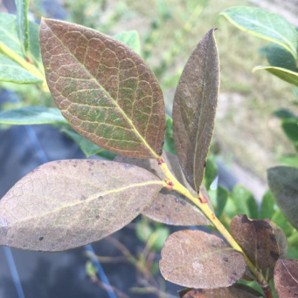
Figure 2. Bronze-colored blueberry leaves associated with southern red mite damage.
Credits: D. Phillips
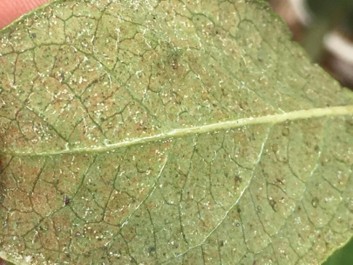
Figure 3. Southern red mite shed skins on underside of leaf.
Credits: D. Phillips
Monitoring and Management
The southern red mite is considered a “cooler weather mite,” with populations peaking in the late fall after hot, dry summer conditions end. Prolonged infestation can be observed where evergreen production is planted under high tunnels. Early and frequent scouting is necessary to identify infestations before extensive bronzing becomes visible. Early scouting should focus on the more shaded leaves of the plant lower to the ground or in the interior of the bush. The undersides of leaves should be examined with a 10-15x hand lens for signs of mites, shed skins, or webbing.
Dusty conditions are favorable for mites, and drought-stressed plants can be more susceptible to mite infestations. Water should be regularly applied to roadways or other dusty areas during hot, dry periods, and sufficient irrigation is particularly important before and during periods of potential mite activity.
Predatory mites are an important management tool that can be used for controlling spider mites. Some predatory mites that have been used in fruit systems include Amblyseius fallicus, Galendromus occidentalis, Mesoseiulus longipes, Neoseiulus californicus, and Phytoseiulus persimilis. However, none of these predators have yet been successfully evaluated in blueberry systems.
Three miticides — Magister® with the active ingredient fenazaquin, Portal® with the active ingredient fenpyroximate, and Kanemite® with the active ingredient acequinocyl — have been registered for use in highbush blueberries. These miticides are all registered for southern red mites. The miticides control all developmental stages, including larvae, nymphs, and adults of southern red mites. Data from University of Florida 2019 field trials in which seven miticides were evaluated indicated that Magister® and Portal® were the best performing ones in terms of suppressing southern red mite populations and allowing bushes to recover from mite injury. Growers can only make one application per year using Magister® and two applications per year with Portal®. Early identification of mite infestations and implementing management techniques before reaching high population numbers is necessary to avoid significant foliage damage and yield impacts.
For more information see UF EDIS Publication ENY-1006, Mite Pests of Southern Highbush Blueberry in Florida (https://edis.ifas.ufl.edu/publication/IN1284) and HS1156, 2024 Florida Blueberry Integrated Pest Management Guide (https://edis.ifas.ufl.edu/publication/HS380).


CREDITS:
DR. OSCAR LIBURD, Professor, UF/IFAS
& DOUG PHILLIPS, Blueberry Extension Coordinator, UF/IFAS